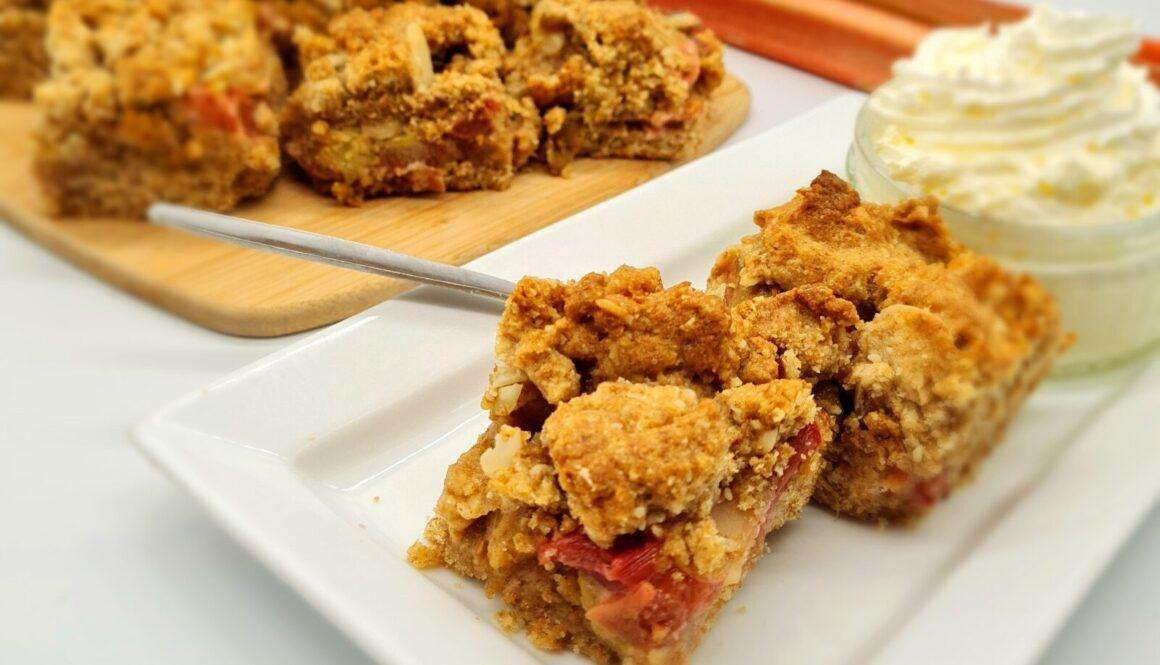
Rhubarb Crumble Squares
Rhubarb often brings up fond childhood memories from crumble complete with lashings of custard, or in my case, sitting on my nana’s step, dipping the freshly picked stalks into the obligatory pot of sugar, then pulling a face because of the tartness!
Seeing as though this vegetable is in season (yes, it is a vegetable, but often referred to as a fruit), I wanted to create something that can be eaten as a snack, as well as a dessert with cream or custard.

I do like to cut corners where I can and save washing up, so rather than make a base mixture, cook the rhubarb, then make a topping, I streamlined this recipe to be a lot simpler.


RHUBARB CRUMBLE SQUARES
Equipment
- Scales
- mixing bowls
- chopping board or plate
- 20cm square baking pan or silicone mould
- Oven
Ingredients
Base & Topping
- 200 g butter softened
- 125 g caster sugar
- 2 eggs
- 1 tsp vanilla extract
- 2 tsp baking powder
- 400 g wholemeal flour if preferred, use plain white flour
- 50 g ground almonds or oats
- 4 tbsp flaked almonds optional
Filling
- 400 g rhubarb washed and cut into 2.5cm chunks
- 1 tbsp custard powder or use flour
- 75 g caster sugar
Instructions
- Oven, 180c
- Beat together the butter and sugar until light and fluffy. Add the eggs and vanilla, beating well. It will look curdled at this point but that is fine.
- Add the baking powder then 100g of the flour. Mix well until the ‘curdling’ has gone, then mix in the remainder of the flour to make a soft dough.
- Press 2/3 of this mixture (about 500g) into a greased/lined 20cm square deep baking pan (I used a silicone baking ‘pan’) and press down with a wet spoon. Keep wetting the spoon to avoid it sticking. Set this aside.
- Add the chopped rhubarb to a clean bowl with the custard powder or flour and the sugar. The custard powder not only adds a vanilla flavour, but helps to absorb some of the juices. Feel free to use flour or cornflour if you don't have custard powder. Toss well to mix then tip this over the dough base and spread out. Press down lightly.
- Add the 50g ground almonds (or oats) and flaked almonds, if using, to the remaining dough mixture and rub this in between your fingers to get a dough that is crumbly. Scatter this over the rhubarb and again, press down lightly.
- Bake for 40 - 45 mins until golden. Leave to cool fully in the pan before cutting into squares. If you want to eat this straight away, that is fine but the squares will fall apart slightly.The traybake squares can be stored in an airtight container for a couple of days, but will last a little longer if kept in the fridge (if they do last that long!)
The recipes are free to everyone to use (please give credits to us if you choose to use them), and always will be, but our non-profit organisation incurs many costs to keep it running. If you would like to help keep it going, please consider giving a donation. If you feel inspired to try more, why not invest in our Recipe Collection, available online or from our Eco Market.
Thank you
Card Donations PayPal Donations
Nutritional Benefits:
Wholemeal flour contains more B vitamins (needed to release energy from nutrients and a healthy nervous system) and vitamin E content than white (helping wound healing, immunity and healthy eyes, skin and red blood cells) as well as insoluble fibre essential for good digestive health and stabilising blood sugars.
Rhubarb has been used as a laxative for thousands of years; the stems are rich in anthraquinones which are substances found in senna and aloe – both used in herbal medicine as natural laxatives. The soluble fibre in rhubarb, like most plant based foods, help bowel function. It is rich in antioxidants, particularly anthocyanins (which give it its red colour) and proanthocyanidins. These antioxidants have anti-bacterial, anti-inflammatory, and anti-cancer properties and may help protect you from many health-related issues such as heart disease, cancer, and diabetes . It is a source of vitamin K (important for bone health, wound healing, and blood clotting), calcium (to build and maintain strong bones – your heart, muscles, and nerves also need calcium to function properly) and vitamin C (supports immunity and helps promote iron absorption. It’s also linked to the reduction of high blood pressure and may lower the risk of heart disease)